
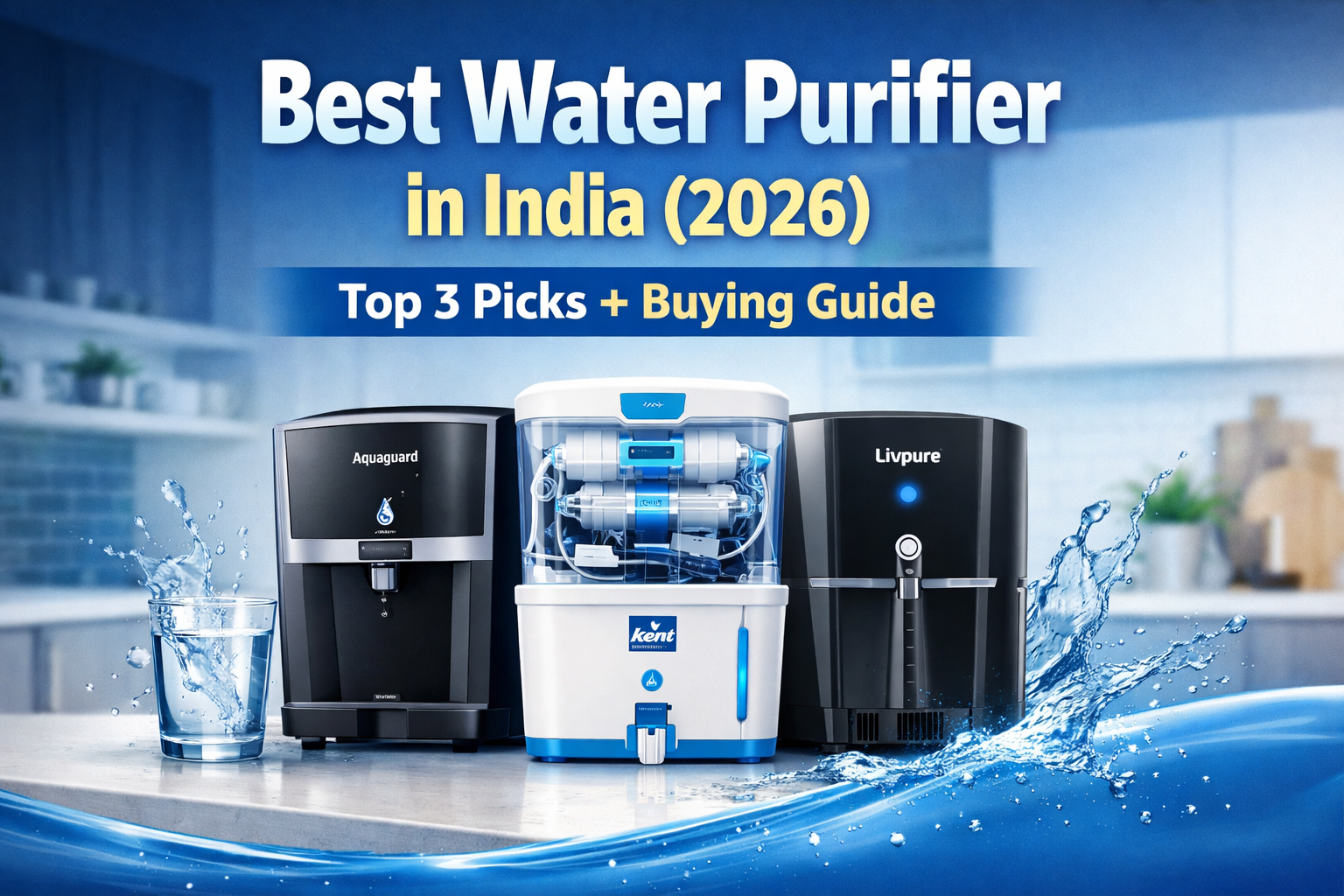
If you’re looking for the best water purifier for home in India, this guide will help you In 2026, water quality in India varies significantly—some areas have safe municipal water, while borewell and tanker water often come with high TDS, hardness, and bacterial risks.
That’s why choosing a random purifier is not the right decision.
In this article, we have evaluated the top 3 water purifiers in India (2026) based on real-world usage, performance, and long-term cost—with a completely practical approach. We have also explained in detail which purifier is suitable for different cities and whether TDS levels actually require one.
Table of Contents
How We Evaluate Water Purifiers
To properly understand each purifier, we consider 4 main factors:
- TDS Reduction (how effectively it removes dissolved salts)
- Microbial Safety (removal of bacteria and viruses)
- Water Recovery (how much water is wasted)
- Maintenance Cost (AMC + filter replacement)
All the products below are evaluated on this basis.
Understanding Water Types in India (Very Important)
- Municipal Water (TDS < 250)
👉 UV + UF is sufficient (RO can be avoided) - Borewell Water (TDS 300–1500)
👉 RO + UV + UF is necessary - Tanker Water (Unpredictable)
👉 RO-based purifier is the safest option
Top 3 Best Water Purifiers in India (2026)
🥇 Aquaguard Aura RO+UV+UF
⭐ Rating: 4.5/5
🔹 Key Features (Why it stands out):
- MTDS Technology – maintains water taste
- Copper + Zinc infusion – for health benefits
- Balanced performance (suitable for all water types)
Opinion:
This is an all-rounder purifier that balances performance, taste, and health.
🥈 Kent Grand Plus RO+UV+UF
⭐ Rating: 4.4/5
🔹 Key Features (Why it stands out):
- Strong TDS control – perfect for hard water
- High purification power
- Trusted brand with a wide service network
Opinion:
If your area has poor water quality, this is the most reliable option.
🥉 Livpure Glo Pro++ RO+UV+UF
⭐ Rating: 4.2/5
🔹 Key Features (Why it stands out):
- Budget-friendly option
- Simple and effective purification
- Easy to use and maintain
Opinion:
If you want decent performance on a low budget, this is the best entry-level purifier.
Verdict
This is a value-for-money option for basic purification.
Performance:
- TDS Reduction → Medium
- Safety → High
- Recovery → Medium
👉 Best for low-budget buyers
Comparison Table
| Feature | Aquaguard Aura | Kent Grand Plus | Livpure Glo Pro++ |
|---|---|---|---|
| Technology | RO+UV+UF+MTDS | RO+UV+UF+TDS | RO+UV+UF |
| Best For | Mixed Water | Borewell | Budget |
| Storage | 7L | 8L | 7L |
| TDS Control | Yes | Yes | No |
| Maintenance | Medium-High | High | Low |
| Price | Medium | High | Budget |
If You’re Confused About Which Purifier to Choose
You can check the latest prices and user reviews:
- Aquaguard Aura (Best for most homes)
- Kent Grand Plus (Best for hard water)
- Livpure Glo (Best budget option)
Which Purifier Should You Choose?
- If your water source is mixed → Aquaguard Aura
- If you use borewell water → Kent Grand Plus
- If your budget is low → Livpure Glo
Final Recommendation
If you want a safe and long-term investment,
👉 Aquaguard Aura is the most balanced choice
But if your water quality is poor (high TDS),
👉 Kent Grand Plus is the better option
Who Should Buy Which Water Purifier?
Every household has a different water type, so one purifier is not suitable for everyone.
- If your home has a mixed water supply (municipal + borewell), Aquaguard Aura is a balanced option that handles both taste and purification.
- If you use borewell or high TDS water, Kent Grand Plus is a better choice as it provides strong purification and handles hard water effectively.
- If your budget is limited or you need a purifier for a small family, Livpure Glo is a simple and affordable option for basic purification.
Quick Summary (2026)
If you want to make a quick decision:
- Aquaguard Aura is the best overall option for most Indian homes
- Kent Grand Plus is best for areas with poor or high TDS water
- Livpure Glo is ideal for budget buyers
Based on this, you can easily choose according to your needs.
RO vs UV vs UF – What’s the Difference?
Understanding these technologies is important before choosing a purifier:
- RO (Reverse Osmosis): Reduces dissolved salts and TDS—useful for high TDS areas
- UV (Ultraviolet): Kills bacteria and viruses, making water microbiologically safe
- UF (Ultrafiltration): Removes dirt and suspended particles
👉 In India, RO + UV + UF combination is generally the safest, especially when water quality is uncertain.
When Should You NOT Buy an RO Water Purifier?
RO is not necessary in every situation.
- If your water TDS is below 300, RO may be unnecessary
- It can remove essential minerals from water
- If you already receive clean municipal water, UV or UF is sufficient
👉 Always check your water TDS before buying a purifier.
Installation & Setup Guide
Installing a water purifier is usually simple.
- Most brands offer free installation or charge ₹500–₹1000
- Purifiers are wall-mounted and require a nearby power supply
After installation, regular maintenance is important:
- Filter replacement
- Timely servicing
This ensures good long-term performance.
City-wise Water TDS Level in India (2026)
Water quality varies across cities, so understanding TDS is crucial.
Major Cities Water TDS Level
| City | Water Source | Avg TDS (ppm) | Recommended Purifier |
|---|---|---|---|
| Delhi | Mixed | 300–900 | RO + UV + UF |
| Mumbai | Municipal | 100–300 | UV + UF (RO optional) |
| Bangalore | Borewell + Tanker | 400–1200 | RO + UV + UF |
| Hyderabad | Borewell | 500–1000 | RO + UV + UF |
| Chennai | Borewell + Tanker | 600–1500 | RO + UV + UF |
| Kolkata | Municipal | 150–300 | UV + UF |
| Pune | Mixed | 300–800 | RO + UV |
| Jaipur | Borewell | 500–1200 | RO + UV + UF |
| Ahmedabad | Borewell | 400–1000 | RO + UV |
| Lucknow | Mixed | 250–700 | RO + UV |
Simple Rule to Understand TDS
- 0–150 ppm → Safe (No RO needed)
- 150–300 ppm → Good (UV/UF enough)
- 300–600 ppm → Moderate (RO recommended)
- 600+ ppm → High (RO + TDS control required)
Important Advice
- If your TDS is below 300, RO is unnecessary
- RO removes minerals from water
- Always check your TDS before choosing a purifier
👉 Buy a ₹200–₹300 TDS meter and test your water at home
👉 Then choose a purifier accordingly (don’t choose randomly)
In India, one purifier is not best for everyone.
👉 “The best purifier = the one that fits your water type”
So, making a decision based on city-wise TDS is the smartest move.
Water Purifier Buying Guide (2026)
- Check TDS level
- Choose storage capacity based on family size
- Consider maintenance cost
- Check brand service availability
Maintenance Cost
💸 Maintenance Cost of Water Purifiers
- RO filter replacement: ₹2000–₹4000/year
- Service: ₹500–₹1000
- AMC plans available
Common Mistakes While Buying a Water Purifier
- Buying without checking TDS
- Choosing a cheap purifier without brand support
- Buying RO when it’s not needed
How to Choose the Right Water Purifier (Expert Guide)
1. Test Your Water First
- Below 200 ppm → UV/UF is enough
- 200–500 ppm → RO is useful
- Above 500 ppm → RO + UV is necessary
2. Match Technology to Water Source
- Borewell/Tanker → RO + UV + UF
- Municipal → UV/UF
- Mixed → RO + UV + UF with TDS control
3. Choose Tank Size Based on Family
- 2–3 members → 5–6L
- 4–6 members → 7–8L
- Large family → 8–10L
4. Think About Long-Term Cost
- Filter replacement
- Service charges
- AMC plans
5. Check Service Support
👉 Always choose a brand with a strong service network
6. Taste & Minerals Matter
👉 Choose a purifier with TDS controller or mineralizer
Performance Comparison (Real-World Analysis)
Choosing a purifier based only on specifications is not enough. Real performance depends on purification quality, maintenance cost, and long-term usability.
Key Performance Factors
- Water Recovery (%)
- TDS Reduction
- Purification Speed
- Maintenance Cost
- Storage Capacity
Performance Comparison Table
| Feature | Aquaguard Aura | Kent Grand Plus | Livpure Glo |
|---|---|---|---|
| Water Recovery | ~45–50% | ~40–45% | ~50–55% |
| TDS Reduction | High (95–98%) | Very High (95–99%) | Medium (90–95%) |
| Purification Speed | Fast | Medium | Medium |
| Storage Capacity | 7L | 8L | 7L |
| Maintenance Cost | ₹3000–₹5000 | ₹3000–₹4000 | ₹2000–₹3000 |
| Best For | Balanced Use | Hard Water | Budget |
Expert Insight (Simple Language)
- Aquaguard Aura is a balanced performer
- Kent Grand Plus is a powerful purifier
- Livpure Glo is a budget-friendly option
👉 Overall:
- Performance winner → Kent
- Balanced choice → Aquaguard
- Budget option → Livpure
Long-Term Cost & Maintenance
- RO filter replacement: ₹2000–₹4000/year
- Service charges: ₹500–₹1000
- AMC plans available
👉 Kent and Aquaguard have higher maintenance but better performance
👉 Livpure has lower cost but limited features
Final Verdict (Expert Recommendation)
- For strong purification and long-term use → Kent Grand Plus
- For balanced performance and better taste → Aquaguard Aura
- For budget-friendly basic use → Livpure Glo
👉 Based on this comparison, you can choose the best purifier according to your needs.
Conclusion
Choosing a water purifier in India is not simple—it depends on your water source.
👉 Don’t buy blindly—choose based on your water type
The 3 options above are practical, tested, and reliable for 2026.
Frequently Asked Questions (FAQs)
Q1. Is an RO water purifier necessary for every home?
👉 No, if TDS is below 300, you can avoid RO
Q2. How often should a water purifier be serviced?
👉 Generally, filters need replacement every 6–12 months
Q3. Is RO water safe for health?
👉 Yes, but low TDS water may lack minerals
Q4. Which is the best purifier in India?
👉 It depends on water type, but Aquaguard Aura is a balanced option
Also Read:
How to Dismantle a Reclining Sofa (Step-by-Step Simple Tips for Safe Removal) 2026 Guide
The 5 Best Recliner Of 2026 | Review, Features, Comparison In Details
5 Best Ergonomic Chair Under $150 for Short Person (2026) – 5 Best Chairs for Petite & Short Height Person

Sumit Pandey is the founder of GyanSaga
I research and write helpful articles on home appliances, gaming gear, and everyday products to help users make better buying decisions.
My recommendations are based on research, user reviews, and real-world use.
Some links may be affiliate links at no extra cost to you.